3 minute read
IT ↔ OT responsibility matrix template
On this page
Bridging IT and OT: A Unified Approach to Responsibility
In modern industrial environments, the boundary between Information Technology (IT) and Operational Technology (OT) is more interconnected than ever. Yet, this convergence often brings uncertainty around who owns what, particularly when it comes to cybersecurity, compliance, configuration, and maintenance.
To address this, Unified IT llc created the IT ↔ OT Responsibility Matrix, a visual framework that establishes clear lines of accountability between IT and OT teams.
The Framework: Built on the Purdue Model
The matrix leverages the Purdue Enterprise Reference Architecture, a well-recognized model for defining industrial control system (ICS) layers, from Level 0 (Process) to Level 4 (Enterprise Systems) and the DMZ in between.
Each layer lists key assets (such as pumps, PLCs, SCADA systems, servers, and databases) and assigns responsibility across governance and operational domains, including:
Governance: Physical Security, Cybersecurity, Compliance, and Operations
Domains: Design, Budget, Procurement, Configuration, Implementation, and Maintenance
By distinguishing between IT, OT, and shared IT/OT responsibilities, the matrix provides a single, transparent view of how control, accountability, and collaboration flow across the organization.
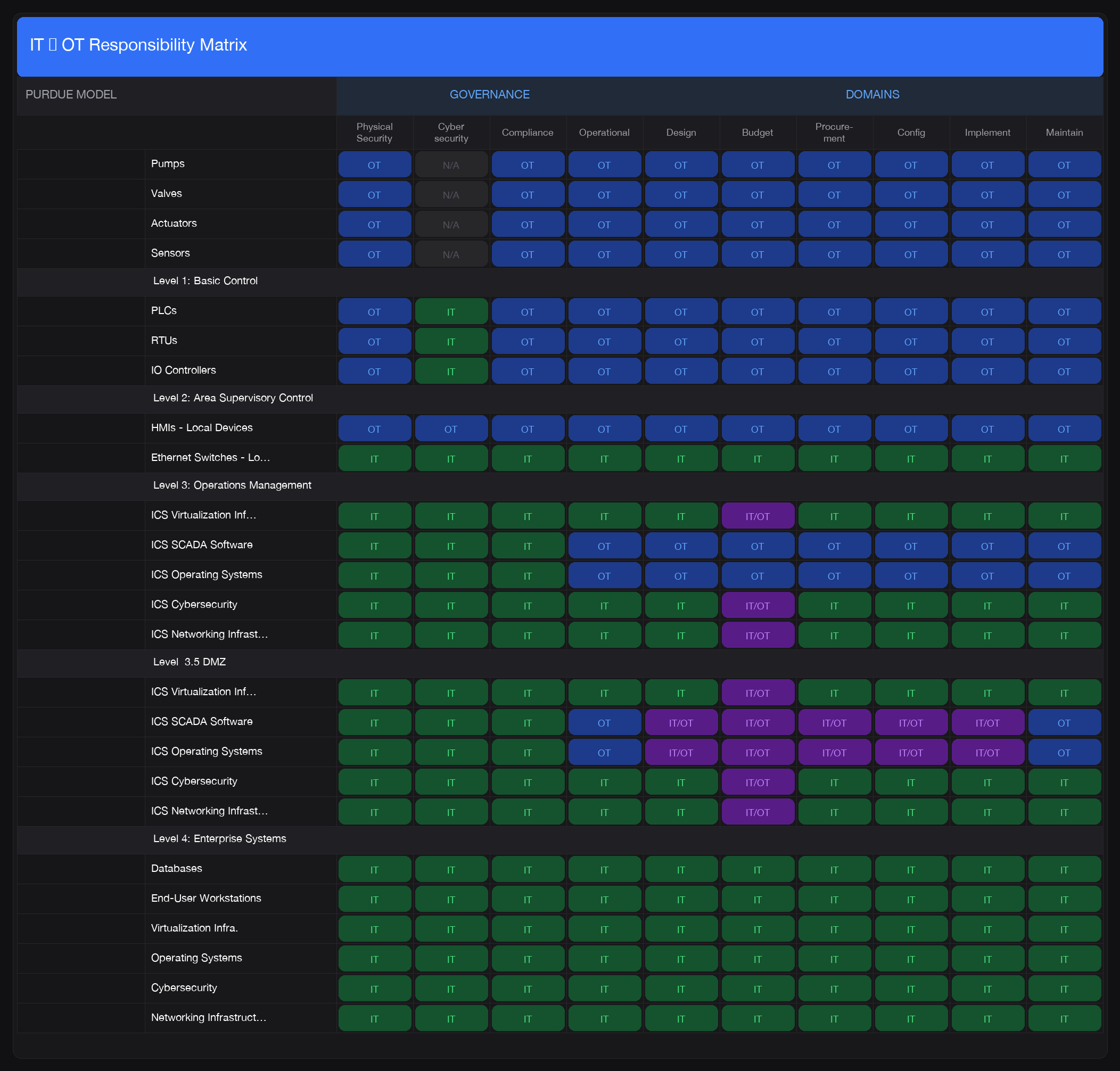
Download the full IT ↔ OT Responsibility Matrix Template (.xlsx) using the link at the bottom of this article.
Key Benefits
Eliminates Overlap and Confusion
Teams know exactly which group is accountable for each asset and function. No more finger-pointing when something goes wrong.
Strengthens Cybersecurity Posture
Defines ownership of cybersecurity responsibilities across both IT and OT systems. When a vulnerability is discovered, there is zero ambiguity about who acts.
Simplifies Cross-Department Collaboration
Encourages coordination between engineering and IT teams, especially around shared infrastructure such as virtualization, networks, and cybersecurity.
Improves Governance
Supports compliance and audit readiness by formalizing operational and technical ownership across every layer of the Purdue Model.
Example Insights
Level 0–1 (Plant Floor): OT holds full responsibility for process devices and control logic: pumps, valves, actuators, sensors, PLCs, and RTUs.
Level 2–3 (Supervisory & Operations): IT begins to share responsibility, especially for networking, virtualization, and cybersecurity. OT retains ownership of SCADA software and operational systems.
Level 3.5 (DMZ): Shared accountability between IT and OT ensures secure data flow between plant and enterprise systems. This is the most critical collaboration zone.
Level 4 (Enterprise): IT assumes full responsibility for corporate infrastructure: databases, workstations, operating systems, networking, and cybersecurity.
Conclusion
The IT ↔ OT Responsibility Matrix is a governance tool for the modern industrial enterprise. By clearly delineating roles across both technical and operational domains, it helps organizations operate more securely, efficiently, and collaboratively.
The IT ↔ OT Responsibility Matrix eliminates the gray areas between IT and OT teams, turning ambiguity into accountability.
Framework: IT-OT-RM Version 1.0, created by Unified IT llc.

Written by
Matthew McManus
Co-Founder, CTO & CISO
Matt oversees technical architecture, backend infrastructure and security on every engagement. His focus is cybersecurity, systems design and infrastructure monitoring.
Matthew's profile